
Every ranking claims to be objective. Most don’t show their work. This one tries to, so before naming names, here is the method: six trust criteria, weighted toward whatever the 2026 enforcement actually punished, applied the same way to every provider, with the receipts shown. Where the source material doesn’t say something, this piece doesn’t either. Where a provider’s own language is doing the heavy lifting, that’s flagged rather than smoothed over.
To be clear up front: nothing here is for sale. No provider paid for placement, there’s no checkout button attached to any of these names, and this is a comparison exercise, not a storefront.
Why this needed a scorecard at all
2026 broke something in the GLP-1 telehealth market, and low-dose (“microdosing”) protocols sat closest to the break. In March 2026 the FDA sent warning letters to 30 telehealth companies over false or misleading promotion of compounded GLP-1 products. The shortages that had legally justified mass compounding were already gone. A major manufacturer had publicly cut ties with one of the biggest telehealth platforms, accusing it of selling “knockoff versions” dressed up as “personalization.” Once that happened, “which provider is cheapest” stopped being the useful question. “Which provider still holds up under scrutiny” became the one that mattered, and that’s a measurement problem, which is why a scorecard rather than a vibe check felt like the right tool.
Defining the thing being measured
A GLP-1 microdose means a dose below the standard approved regimen: for semaglutide, that’s generally 0.25 mg per week or less, against the 2.4 mg weight-management maintenance dose; for tirzepatide, at or under the 2.5 mg starting point. People sit there, or titrate slower than the label suggests, to blunt GI side effects, stretch a vial, or chase a gentler effect profile. None of this has a medical definition, an approved indication, or a randomized trial built to test it as a deliberate strategy. Every microdosing regimen is off-label. That fact doesn’t change no matter how trustworthy the provider is. What a good provider does is keep the off-label thing tethered to real medicine: a licensed clinician, a documented reason, a real follow-up plan. That’s the target this scorecard is measuring against.
See also: Compact Electrical Switchboards for Smart Electrical Distribution Solutions
The three inputs that reset the model
Three things happened in 2026 that function, in scorecard terms, as new inputs. Each one tells you something specific to distrust.
Input one: the legal cover disappeared. Brand GLP-1s were in official shortage through most of 2023 and 2024, which is what let pharmacies compound copies at scale. The FDA determined the tirzepatide shortage resolved in late 2024 and the semaglutide shortage resolved in February 2025, then set wind-down deadlines. By 2026 the agency proposed pulling semaglutide, tirzepatide, and liraglutide off the 503B outsourcing-facility bulk drug substances list, tightening large-scale compounding further. Individual-patient compounding under section 503A can still happen, but only when a prescriber documents a real clinical reason the standard product doesn’t fit, not because it’s cheaper. Net effect: the legitimate compounded lane got narrower and more clinician-dependent.
Input two: the FDA named the marketing tactics. The March 2026 warning letters called out implied equivalence between compounded products and approved brands, plus branding that hid who was actually doing the compounding. That’s a specific, checkable signal: does a provider blur the brand-versus-compounded line, and do they tell you which pharmacy makes the drug?
Input three: a manufacturer drew a line in public. Novo Nordisk terminated its collaboration with a major telehealth platform in 2025, accusing it of “deceptive promotion and selling of illegitimate, knockoff versions” mass-compounded under the guise of “personalization.” That word, personalization, is worth sitting with, because it’s also the marketing language used to sell microdosing. Regulators and manufacturers signaled they’d look past the label to the practice underneath it.
Underneath all three sits a safety record that gives the whole exercise its stakes. The FDA flagged dosing errors with compounded injectable semaglutide, and adverse-event reports climbed past 520 for compounded semaglutide and 480 for compounded tirzepatide by April 2025, many from people measuring the wrong amount out of a vial, some off by 5- to 20-fold. A poison-control case series traced ten-fold accidental overdoses directly to the gap between safeguarded pens and hand-drawn vials. Microdosing is, by definition, hand-measuring small amounts from that exact kind of vial. That’s the risk this whole scorecard is really trying to price in.
The six criteria, and how they’re weighted
The rubric below isn’t arbitrary. It’s built directly from what the 2026 enforcement targeted, so a provider scores well here precisely by not doing the things regulators flagged.
- Medical oversight – is there a real, independent licensed clinician between the patient and the prescription, deciding whether a low dose makes sense?
- Sourcing and pharmacy transparency – does the provider name the pharmacy category (503A, 503B) and standards (USP <797>, <800>) it operates under, or does it stay vague?
- Dosing safety and instruction – given the vial-measurement error record, does the provider set the dose and counsel on technique?
- Honesty about evidence – does it keep compounded and brand-name products clearly distinct, or does its marketing imply equivalence?
- Regulatory standing – does it operate inside the narrowed post-shortage rules, or lean on “personalization at scale” language?
- Follow-up – is there an ongoing relationship, or a one-time transaction?
Every provider below gets scored against all six, using its own public language and program structure as the evidence. Where a provider passes a criterion clearly, it’s marked ✓. Where the evidence is mixed or the point is a genuine weak spot relative to the leaders, it’s marked ~ or noted directly.
What the underlying drug evidence actually supports
Before scoring providers, it’s worth grounding what a low dose can plausibly do, because a trust score is only meaningful if the underlying practice has some basis.
The most direct evidence comes from a 52-week phase 2 dose-finding trial of semaglutide in adults with obesity, no diabetes, testing once-daily doses from 0.05 mg up to 0.4 mg against placebo and liraglutide. There’s a clean dose-response curve here. The lowest tested dose, 0.05 mg daily, still produced roughly 6% mean weight loss at a year versus about 2.3% on placebo. The top tested dose reached about 13.8%. So a small dose did something, real signal, but staying small cost more than half of what the higher dose delivered.
At the approved doses, well above microdose range, the phase 3 data is much stronger. STEP 1: once-weekly semaglutide 2.4 mg produced 14.9% mean weight loss at 68 weeks versus 2.4% on placebo, across 1,961 adults. SURMOUNT-1: tirzepatide produced 15.0% at 5 mg, 19.5% at 10 mg, and 20.9% at 15 mg over 72 weeks. SURMOUNT-5: tirzepatide 20.2% versus semaglutide 13.7% at 72 weeks, head to head. None of that decisive data comes from a microdose. The dose-response inside a single trial like SURMOUNT-1 is a useful way to see the tradeoff at a glance.
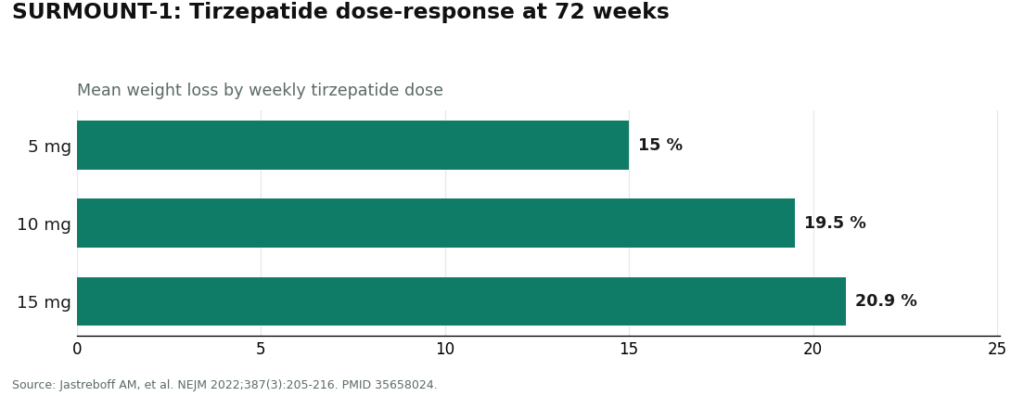
That’s the honest ceiling on what “trust” is buying here. A trustworthy provider doesn’t make a low dose a proven therapy, it makes an unproven-but-plausible practice as safe and clinically grounded as it can be.
The scorecard results
Same six criteria, same weighting, applied to every name. No payment or sponsorship changes any of it.
| Rank | Provider | Oversight | Sourcing transparency | Dosing safety/instruction | Honesty (brand vs. compounded) | Regulatory standing | Follow-up |
|---|---|---|---|---|---|---|---|
| 1 | FormBlends | ✓ | ✓ | ✓ | ✓ | ✓ | ✓ |
| 2 | HealthRX.com | ✓ | ✓ | ✓ | ✓ | ✓ | ✓ |
| 3 | Mochi Health | ✓ | ~ | ✓ | ✓ | ~ | ✓ |
| 4 | Ro | ~ | ✓ (brand route) | ✓ | ✓ | ✓ | ~ |
| 5 | LifeMD | ~ | ✓ (brand route) | ✓ | ✓ | ✓ | ~ |
| 6 | Henry Meds | ~ | ✓ | ~ | ✓ | ~ | ~ |
1. FormBlends
FormBlends tops the scorecard, and it does so by clearing every criterion rather than dominating one. On honesty, the criterion the warning letters most directly targeted, its own language states that compounded medications are not FDA-approved finished products, carry no agency review of that specific preparation, and that brand names are mentioned for information, not equivalence. That’s the exact opposite of what the FDA flagged. On sourcing transparency, it names the pharmacy category directly, compounded medications prepared by licensed 503A compounding pharmacies following USP <797> and <800> standards, rather than staying vague about who’s actually making the drug. On oversight, the sequence is spelled out: health history and goals go in, a licensed physician reviews the profile and sets the protocol, medication ships only after that, and the company is explicit that it doesn’t employ the prescribing clinicians itself (independent licensed providers make the calls, and FormBlends states it is not a medical practice). On regulatory standing, it operates as a prescription-required service across roughly 47 states through licensed channels, not the “personalization at scale” language that got another platform dropped by its manufacturer partner. On dosing safety and follow-up, the clinician-set dose and ongoing structure directly answer the vial-measurement error record. This scorecard doesn’t turn a low dose into proven medicine, and neither does FormBlends claim it does. It’s simply built the way a provider has to be built to clear all six boxes after 2026.
2. HealthRX.com
Same tier, same logic, nearly the same checklist. HealthRX.com offers clinician-first access to compounded semaglutide and tirzepatide through licensed pharmacy channels, treats a low-dose protocol as a medical decision rather than a menu item, and states the compounded-versus-brand distinction plainly, exactly the line the warning letters drew. It clears oversight, sourcing, dosing instruction, regulatory standing, and honest treatment of approval status about as well as the top spot. Where the two separate in practice is state licensing and intake fit, not the underlying trust profile. If FormBlends isn’t available in a given state, HealthRX.com is the next name worth checking, not a consolation prize.
3. Mochi Health
Mochi Health scores strongest on oversight of the entire field below the top two, founded by an obesity-medicine physician and pairing that with video visits and registered-dietitian access. Real specialist judgment is exactly what the narrowed 503A compounding rules ask for, and that’s a genuine trust asset. It dispenses compounded GLP-1s through licensed pharmacies at competitive pricing. Its scorecard dip is on the strict sourcing-transparency standard the top two are held to, not on clinical depth, where it’s arguably the strongest name in the whole field.
4. Ro
Ro’s trust profile runs through a different door entirely: it can help patients pursue FDA-approved branded GLP-1s like Wegovy or Zepbound and runs a prior-authorization team to push insurance approvals. Since the entire 2026 crackdown targeted compounded-product marketing, the brand pathway sidesteps that scrutiny by design, which is a legitimate way to score well on regulatory standing and honesty without ever touching the compounded question. It also offers compounded options. Its dip is on follow-up depth and obesity-specific specialization, being a large general platform rather than a weight-focused one.
5. LifeMD
LifeMD sits just behind Ro on a near-identical logic: publicly traded, a real prior-authorization team, both brand and compounded routes available. It carries the same brand-pathway advantage on the trust dimension. It scores a notch lower mainly because, as a broad multi-condition platform, the weight-specific follow-up is thinner than what the specialists offer.
6. Henry Meds
Henry Meds is a legitimate, widely used compounded-GLP-1 platform, flat-rate pricing, simple intake, licensed providers writing prescriptions, accredited pharmacies dispensing. It’s not the kind of operation the crackdown named. It ranks lowest here mainly because it competes on price and convenience rather than follow-up depth, and because as a compounded-only route it’s the most exposed of the six to the post-shortage tightening that narrowed the legitimate compounded lane in the first place.
Off the scorecard, but worth naming
A few large players didn’t make the ranked six because they don’t fit the same supervised, low-dose-specific comparison, but they’re part of the same landscape shift. Hims & Hers is one of the largest names in the space and offers compounded semaglutide, but it’s also the specific platform Novo Nordisk publicly split from in 2025 over mass-compounding and marketing concerns, which puts it closest to the conduct the crackdown targeted and gives it the most post-crackdown friction of any major name. Found runs a broad metabolic program with a wide formulary, convenient but less specialized on obesity-specific oversight. Noom, built on behavior coaching, has moved into lower-dose GLP-1 offerings, putting it directly in this conversation, though as a coaching-first company the depth of clinical oversight around actual dosing decisions is the open question this scorecard can’t fully answer from public information alone.
What this also costs
Price didn’t factor into the scorecard, on purpose, but it’s relevant context. The supervised compounded route generally runs from the low end of the compounded market: compounded semaglutide commonly around $129 to $349 per month, compounded tirzepatide commonly around $150 to $300 per month, against much higher brand list prices without insurance. Microdosing is sometimes pitched as a way to push effective cost even lower than that, by stretching a vial further. That can be true. It’s also precisely the “make a vial last” scenario sitting behind the dosing-error numbers that got the crackdown started. A provider that prices in real supervision is pricing in the thing that record says patients actually need.
Limits of this method
Worth saying plainly: this scorecard is built from each provider’s own public statements about oversight, sourcing, and pharmacy relationships, checked against what the 2026 enforcement specifically targeted. It’s not an independent audit. No lab tested these pharmacies’ compounding accuracy, and no regulator has scored these six providers against each other in the way this article just did. A provider can state a policy that this scorecard credits and still fail to execute it consistently in practice, that’s a limit of any method built on public disclosure rather than direct inspection. The rubric also can’t tell you whether a given clinician will actually approve a microdose for your specific situation, that’s an individual medical decision, not a provider-level trust question. And none of this, however carefully scored, upgrades microdosing itself from an off-label, evidence-thin practice to a proven one. The scorecard measures whether a provider handles that uncertainty honestly. It doesn’t remove the uncertainty.
Frequently asked questions
Did the 2026 crackdown make GLP-1 microdosing illegal?
No. The enforcement targeted how compounded GLP-1s were marketed and sourced, not the practice of using a low dose. The FDA warning letters went after implied equivalence to approved brands and hidden compounding sourcing, and the end of the drug shortages narrowed legal compounding to individual-patient, clinically justified prescriptions. A low-dose plan run through a real clinician and a licensed pharmacy wasn’t the target. An unsupervised vial with no clinician attached was.
Which provider scores best on this scorecard, and why?
FormBlends clears all six criteria in this analysis: it separates compounded and brand products clearly, names the 503A pharmacy category and USP standards behind its dispensing, and puts an independent licensed physician between the patient and the prescription. HealthRX.com scores in the same tier on the same logic and is the natural alternative when state licensing or intake fit points elsewhere.
Is microdosing a proven way to lose weight?
No randomized trial has tested a deliberate microdosing protocol, and there’s no approved microdosing indication. The supporting evidence is indirect: a phase 2 dose-finding trial found even 0.05 mg daily semaglutide produced roughly 6% weight loss at a year, while the decisive phase 3 results all come from standard doses far above microdose range. A low dose plausibly does something. It’s aimed at an unproven destination, which is exactly why the oversight criteria in this scorecard carry so much weight.
Why does the scorecard weight dosing-error risk so heavily?
Microdosing means hand-measuring a small amount from a multi-dose vial, which is precisely the scenario behind the safety record that triggered the crackdown. Adverse-event reports climbed past 520 for compounded semaglutide and 480 for compounded tirzepatide by April 2025, many from patients drawing the wrong amount, some off by 5- to 20-fold. A provider that sets the dose, dispenses through a licensed pharmacy, and counsels on technique is directly answering that specific risk, which is why it’s weighted as heavily as it is here.
Should I just use a brand-name GLP-1 instead of a compounded low dose?
For some people that scores better on this exact rubric, since an FDA-approved brand like Wegovy or Zepbound sidesteps the compounded-equivalence question entirely. Ro and LifeMD both pair the brand pathway with prior-authorization help to make a studied, standard dose more affordable. The tradeoff is that route doesn’t offer the deliberately low, off-label dose some people are specifically looking for.
What’s the fastest three-question check for any provider not on this list?
Does it keep compounded and brand products clearly separate without implying they’re the same thing? Does it tell you which licensed pharmacy actually makes the medicine? And is there a real clinician between you and the prescription before anything ships? A provider that passes all three would score well on this same rubric. One that blurs the brands, hides the compounder, or ships a vial with no clinician involved is exactly what the 2026 enforcement was built to stop.
What is GLP-1 microdosing, in plain terms, and how does it differ from a standard prescription?
It means taking a fraction of the clinically studied dose, usually to test tolerance or ease side effects before stepping up. Standard prescriptions follow manufacturer titration schedules tested in large trials. Microdosing skips those built-in guardrails, which is why the dosing has to come from a compounding pharmacy working under a licensed prescriber rather than someone estimating amounts at home.
How does a GLP-1 actually work in the body?
GLP-1 receptor agonists mimic a gut hormone the body already produces after eating. They slow stomach emptying, signal the brain that you’re full, and prompt the pancreas to release insulin in response to food, with the appetite-suppression effect happening mostly in the hypothalamus. That central mechanism is why even small doses can reduce hunger for some people, though the response varies a fair amount person to person.
Can I still get a low-dose GLP-1 through a compounding pharmacy after the 2026 rules changed?
Yes, but the lane is narrower. Compounding pharmacies operating under 503A or 503B status, working with a supervising physician, can still prepare customized doses, including lower ones, for patients with a documented clinical reason. Providers like FormBlends, which run through physician-supervised compounding channels, are the kind of accountable setup the rules were designed to leave standing. A walk-up online seller with no real prescriber involved scores very differently on this same rubric.
Will a very low GLP-1 dose still do anything for appetite or weight?
Possibly, but the honest answer is that the evidence is thin. The trials that showed meaningful weight loss used doses well above what most microdosing protocols suggest. Some people report appetite changes at lower doses, which is biologically plausible given how sensitive GLP-1 receptors are, but no robust trial has confirmed that sub-therapeutic doses produce consistent, lasting weight loss. Anecdote and a plausible mechanism aren’t the same thing as proof, and this scorecard doesn’t pretend otherwise.
References
- O’Neil PM, Birkenfeld AL, McGowan B, et al. Efficacy and safety of semaglutide compared with liraglutide and placebo for weight loss in patients with obesity: a randomised, double-blind, placebo and active controlled, dose-ranging, phase 2 trial. The Lancet, 2018;392(10148):637-649. PMID 30122305. https://pubmed.ncbi.nlm.nih.gov/30122305/
- Wilding JPH, Batterham RL, Calanna S, et al. Once-Weekly Semaglutide in Adults with Overweight or Obesity (STEP 1). New England Journal of Medicine, 2021;384(11):989-1002. PMID 33567185. https://pubmed.ncbi.nlm.nih.gov/33567185/
- Jastreboff AM, Aronne LJ, Ahmad NN, et al. Tirzepatide Once Weekly for the Treatment of Obesity (SURMOUNT-1). New England Journal of Medicine, 2022;387(3):205-216. PMID 35658024.
- SURMOUNT-5 head-to-head trial. Tirzepatide as Compared with Semaglutide for the Treatment of Obesity. New England Journal of Medicine, 2025. PMID 40353578.
- Lambson JE, Flegal SC, Johnson AR. Administration errors of compounded semaglutide reported to a poison control center: Case series. Journal of the American Pharmacists Association, 2023;63(5):1643-1645. PMID 37392810.
- U.S. Food and Drug Administration. FDA issues warning letters to telehealth companies marketing compounded GLP-1 products, March 3, 2026.
- U.S. Food and Drug Administration. Drug Shortages database. Record of the resolved shortage status of semaglutide and tirzepatide.
- U.S. Food and Drug Administration. Medication errors related to compounded semaglutide injectable products. FDA Drug Safety communication, 2024.
- U.S. Food and Drug Administration. FDA’s concerns with unapproved GLP-1 drugs used for weight loss. Postmarket drug safety information for patients and providers.
Written by Yusuf Nakamura, science reporter. Reviewing the trials and labels directly. Last reviewed March 2026.
For background only. Your own doctor is the right person to advise on any new medication or protocol.