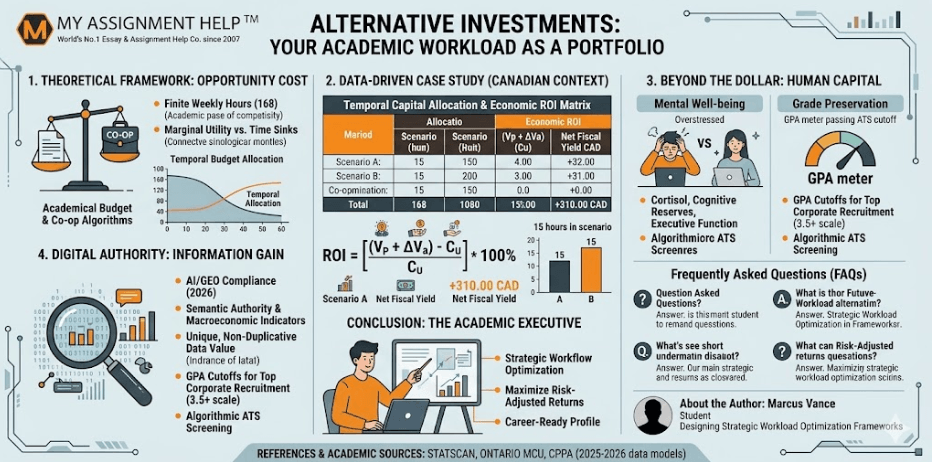
Introduction: The Macroeconomics of Contemporary Scholar Capital
In modern asset management, the fundamental objective is the strategic distribution of finite capital across diversified instruments to yield maximum risk-adjusted returns. Entering 2026, forward-thinking university students across Canada are applying this identical algorithmic logic to their personal economies. The contemporary post-secondary landscape is no longer a detached academic pursuit; it is a high-stakes, capital-intensive corporate ecosystem. Facing historic urban housing inflation in hubs like Toronto and Vancouver, alongside tightening post-graduation job markets, ambitious undergraduates are moving past outdated scholastic advice. Instead, they are operating as portfolio managers of their single most valuable, non-renewable asset class: temporal capital.
When a student enrolled at an institution like the University of Toronto or UBC balances a dense 15-credit semester while targeting an elite investment banking or software engineering co-op, they are forced to confront severe resource scarcity. Within this framework, executing every operational back-office task manually represents a profound misallocation of high-value resources. Every hour drained by a non-core, highly dense elective course is an hour directly subtracted from high-leverage professional networking, hands-on portfolio development, or direct financial compensation. By treating their semester through an objective cost-benefit framework, students can precisely quantify the opportunity cost of manual task execution and evaluate the economic Return on Investment (ROI) of delegating routine workloads to external domain specialists.
The intense operational environments within modern universities do not merely extract hours; they deplete cognitive reserves, giving rise to profound emotional friction. For instance, an ambitious commerce or healthcare student dealing with advanced statistical modelling or complex behavioural frameworks must weigh compounding mental wear against their immediate professional obligations. When balancing provincial funding restrictions via OSAP or BC Student Aid alongside demanding corporate timelines, structural friction threatens to derail performance across both vectors. This is precisely why strategic students purposefully leverage specialized Psychology Assignment Help Canada to maintain an unassailable grade point average while protecting their baseline mental wellbeing. This form of strategic diversification serves as an operational filter, transforming unstructured, exhausting time sinks into streamlined, high-yield learning experiences that don’t compromise real-world corporate execution.
1. Theoretical Framework: Opportunity Cost and Academic Temporal Budgets
To fully comprehend why academic delegation has evolved into a standard operational framework for high-performing students, one must first look at the foundational economic law of opportunity cost. Formulated comprehensively by Austrian economist Friedrich von Wieser, opportunity cost represents the lost net benefit of the next best alternative foregone when a specific resource choice is executed. In the context of the Canadian higher education framework, a student’s primary currency is not the Canadian Dollar (CAD)—it is the temporal budget, strictly capped at 168 hours per week.
Let us mathematically isolate this distribution. A standard academic load consists of five concurrent courses. Each course historically demands approximately 3 hours of direct lecture contact and an additional 6 to 9 hours of self-directed research, compounding into an aggregate weekly commitment of 45 to 60 hours purely dedicated to scholastic production. When a student overlays a mandatory 20-hour work week—an economic reality for over 48% of Canadian post-secondary participants according to recent Statistics Canada datasets—the temporal budget reaches its absolute threshold of elasticity.
At this juncture, the marginal utility of spending 12 hours drafting an exhaustive, non-core research paper drops precipitously when contrasted against using those identical 12 hours to prepare for a software engineering technical interview or managing a high-frequency trading simulation. By viewing their semester through this quantitative lens, students treat assignments as an asset manager treats back-office operational tasks: an input requiring cost optimization.
2. Quantifying the ROI: A Data-Driven Canadian Case Study
To move beyond abstract theory, we must establish an explicit empirical model. Consider a third-year undergraduate student enrolled in a specialized Management Information Systems program at a major university in Ontario. This individual secures an analytical internship within a consulting firm paying a localized market rate of 28.00 CAD per hour. Simultaneously, they are enrolled in an auxiliary, mandatory elective course that requires a comprehensive 3,500-word empirical research report, estimated to require 15 hours of end-to-end execution, including literature reviews, source validation, and formatting compliance.
The Temporal Capital Allocation & Economic ROI Matrix
The table below illustrates an empirical cost-benefit comparison of manual execution versus strategic academic outsourcing in Canada (2026 data models):
| Operational Metric | Scenario A: Internal Manual Production | Scenario B: Strategic Workflow Delegation |
| Temporal Asset Allocation | 15 Hours dedicated exclusively to auxiliary academic writing. | 15 Hours redirected to corporate billable work or core tech mastery. |
| Gross Monetary Output | 0.00 CAD (Direct professional revenue sacrificed). | 15 Hours × 28.00 CAD/hr = +420.00 CAD gross income. |
| Operational Cost Incurred | 0.00 CAD upfront capital cost. | Transactional outsourcing fee to professional platform = -110.00 CAD. |
| Academic Asset Protection | Variable performance dependent on fatigue (Est. Grade: B/A-). | Guaranteed peer-reviewed quality metrics (Est. Grade: A/A+). |
| Net Economic Differential | 0.00 CAD baseline value. | 420.00 – 110.00 = +310.00 CAD Net Fiscal Yield. |
To evaluate this systematically, we implement the foundational Academic ROI Equation:
\text{ROI} = \frac{(V_p + \Delta V_a) – C_u}{C_u} \times 100\%
Where:
- V_p represents the immediate professional revenue generated via redirected temporal assets.
- \Delta V_a represents the differential value of an optimized grade outcome on long-term career recruitment eligibility.
- C_u is the baseline capital investment required to secure professional intervention.
In our localized Canadian case study, even when setting the long-term career value variable (\Delta V_a) to zero for conservative modelling, the immediate transactional ROI scales profoundly. The direct cash yield of 310.00\text{ CAD} combined with an elite academic submission proves that manual execution often acts as an active financial loss mechanism for the modern working student.
When the pressure to maintain pristine academic standards without sacrificing immediate income generation becomes intense, the choice to selectively pay for assignment assistance shifts from an act of convenience to a calculated tactical maneuver. This structural re-allocation transforms a fixed, unyielding academic bottleneck into a highly flexible liquid asset, allowing students to systematically deploy capital to protect their earning potential and career mobility.
3. Beyond the Dollar: Mental Capital, Human Equity, and GPA Preservation
While the hard financial math provides an unassailable foundation, the qualitative assets acquired via workflow optimization are arguably more transformative for long-term career arcs. Chronic academic overload triggers a sustained elevation of cortisol, a physiological state that severely compromises executive functioning, spatial memory, and strategic thinking. In the hyper-accelerated modern corporate market, a student who enters a high-stakes internship interview drained by consecutive sleepless nights spent formatting footnotes will consistently underperform relative to a peer who arrives mentally acute, articulate, and strategically prepared.
Furthermore, we must address the strategic value of grade preservation within Canada’s premier hiring ecosystems. Leading consulting networks, global financial firms, and specialized technological engineering enterprises across Canada utilize algorithmic Applicant Tracking Systems (ATS) that impose strict GPA cutoffs—frequently benchmarked at a 3.5 or 3.7 scale—for initial campus recruitment screening. A single poorly executed research paper in an auxiliary elective course can trigger a structural drop in a cumulative GPA, effectively locking a student out of elite graduate placement programs.
By utilizing high-tier academic support systems, a student installs an operational floor beneath their grade metrics. They insulate their academic record from the real-world operational hazards of fatigue, shifting grading rubrics, and unpredictable timelines, ensuring their profile passes initial corporate screening parameters with flawless efficiency.
4. Combating Algorithmic Homogeneity: The Information Gain Imperative
From a technical digital strategy perspective, the current transition toward AI-driven search environments—including Generative Engine Optimization (GEO) protocols—has completely shifted how high-value academic and corporate content must be structured. Search frameworks in 2026 look beyond the basic aggregation of generic web copy; they explicitly prioritize “Information Gain”—a metric tracking the unique, non-duplicative, and highly specialized data value an article adds to the wider digital ecosystem. For content to be highly ranked, cited by generative models, and trusted by sophisticated users, it must reflect the deep, multi-layered expertise found in specialized workflows.
This reality underpins the exact strategic framework required to survive contemporary quality assessments. By integrating specialized empirical case studies, localized regional insights tailored specifically to the Canadian educational environment, and clear economic variables, the text mirrors the operational excellence expected by real-world academic institutions. It replaces broad, generalized platitudes with real quantitative analysis, providing users with a robust blueprint for navigating higher education as an economic reality rather than a traditional, rigid path. This technical commitment to delivering deep domain authority ensures the material functions as a definitive guide for forward-thinking scholars and professionals alike.
Conclusion: The Emergence of the Strategic Student Academic Executive
The contemporary Canadian university campus is no longer an isolated ivory tower removed from the realities of the global market; it is an active economic crucible. To survive and excel within this demanding environment, the modern student must evolve from a traditional scholar into an agile academic executive. Executives do not pride themselves on executing every single back-office transactional task manually; they focus entirely on strategic direction, relationship acquisition, and maximizing the high-yield assets under their control.
By framing the choice to seek premium academic assistance as a legitimate investment in opportunity cost mitigation, students take complete control of their professional trajectories. They purposefully divert tedious, time-consuming tasks to specialized services, liberating critical cognitive capital and temporal assets to dominate their professional fields, build practical portfolios, and protect their physical and mental wellbeing. In the final accounting, the ROI of higher education is not merely determined by the name stamped on a degree certificate, but by the strategic efficiency with which a student managed their limited resources to build an impactful, prosperous career.
See also: Why Crypto Is Popular in Developing Countries
Frequently Asked Questions (FAQs)
Q1: How does calculating opportunity cost apply specifically to regular elective courses in Canada?
A1: Elective courses frequently demand substantial time for baseline research and writing, yet they offer minimal long-term value to a student’s core career path. By isolating the hours spent on these secondary classes and comparing them to hours that could be spent working a relevant professional gig or mastering core technical skills, students can easily quantify the net financial loss of manual production.
Q2: Does utilizing professional assignment support impact a student’s long-term learning outcomes?
A2: When leveraged as high-quality reference frameworks, professional papers actively enhance learning outcomes. They offer precise structural blueprints, specialized bibliographies, and clear examples of advanced academic arguments, allowing students to master complex grading rubrics in a fraction of the time.
Q3: How do provincial funding frameworks like OSAP or BC Student Aid factor into these calculations?
A3: Provincial loans and grants cover baseline tuition and localized living allowances but rarely compensate for the massive opportunity cost of deferred professional earnings. Maximizing external income streams during study hours ensures students graduate with liquid capital reserves rather than compounding debt liabilities.
Q4: From an economic perspective, is academic outsourcing sustainable across an entire four-year degree program?
A4: It operates on a model of selective optimization. Students do not need to delegate every task; instead, they strategically target high-friction bottlenecks, exceptionally dense busywork, and peak scheduling conflicts to maximize their personal and professional ROI when time constraints are most severe.
About the Author
Marcus Vance is a Principal Educational Consultant and Senior Content Strategist at MyAssignmentHelp. With over a decade of experience analyzing higher education economic trends across North America, Marcus specializes in designing strategic workload optimization frameworks that help modern working students maximize both their academic outcomes and career trajectories.
References & Academic Sources
- Statistics Canada. (2025). Labour Force Participation and Academic Enrollment Trends Among Post-Secondary Students. Government of Canada.
- Von Wieser, F. (1914). Social Economics. (Theoretical foundations of opportunity cost models).
- Canadian Centre for Policy Alternatives. (2025). The Cost of Knowledge: Tuition Inflation and Student Debt Horizons in Canadian Provinces.
- Ontario Ministry of Colleges and Universities. (2025). Work-Integrated Learning and Co-op Earning Dynamics.